How to Handle 50+ WhatsApp Orders Daily Without Going Crazy

Getting your first few sales on WhatsApp feels incredible. The notification pings, you chat with the customer, answer their questions, share your catalog PDF, and manually note down their shipping address. It feels like a real, intimate business connection. You are building relationships one message at a time. But what happens when 5 orders a day turns into 50? What happens during a holiday rush or a viral Instagram Reel? What was once exciting quickly becomes a logistical nightmare of copy-pasting addresses, losing track of payments, and accidentally missing orders. The very tool that helped you start your business is now actively preventing it from growing.
Managing orders through a chat interface is fundamentally broken. WhatsApp was built for conversational messaging, not inventory management or logistics tracking. As you scale, relying on chat for transactions will inevitably lead to burnout, unhappy customers, and stalled growth. You simply cannot type fast enough to compete with an automated website. When a customer messages you at 2:00 AM asking for a price, they don't want to wait until 9:00 AM for a reply—they want to buy immediately.
The transition from manual selling to automated systems is the single most important hurdle a small business owner faces. It requires stepping back from the day-to-day grind of answering basic questions and trusting software to handle the heavy lifting. In this guide, we will break down exactly why manual WhatsApp ordering caps your revenue, the hidden costs of human error, and how you can seamlessly transition your buyers to a centralized dashboard without losing the personal touch that made your brand special in the first place.
- TL;DR: The scaling bottleneck
- 01. The exhausting anatomy of a chat order
- 02. 10 signs you need to automate
- 03. The hidden costs of human error
- 04. The Solopreneur vs The CEO
- 05. Moving to a centralized dashboard
- Order Management FAQ
TL;DR: The scaling bottleneck
You cannot scale a business using a chat app built for personal messaging. Manual data entry is slow, error-prone, and visually exhausting for the buyer. By moving your catalog to a dedicated website, you completely eliminate manual order entry, automate payment tracking with integrated gateways, and reclaim hours of your day.
More importantly, you train your customers to self-serve. WhatsApp then evolves from a bottleneck into a powerful tool for high-ticket marketing, personalized VIP support, and post-purchase relationship building, rather than a frustrating barrier to entry for basic sales.
Pro Tip: Reclaim Your Time
"Stop copying and pasting addresses. With Bizvistar, orders flow directly into a clean dashboard, ready for fulfillment, letting you focus on scaling rather than typing."
01. The exhausting anatomy of a chat order
To understand why manual selling breaks, we must dissect the process. Every single transaction through WhatsApp requires a minimum of five distinct touchpoints. You have the initial query, the catalog exchange, the negotiation or price confirmation, the payment verification, and finally, the address collection.
When multiplied by 50 customers, you are sending over 250 manual messages a day just to process basic transactions. This doesn't even account for customers who ask questions but don't buy, or customers who take three days to reply with a pincode. It is a fragmented, asynchronous nightmare that leaves you constantly checking your phone, terrified of missing a message.
The 5 stages of WhatsApp chaos
The Query
Customer asks 'Is this available?' or 'Price?'. You manually check stock and reply.
The Catalog
You send a heavy PDF or dozens of photos. They take hours to reply.
The Payment
You send your UPI ID. They send a screenshot. You check your bank app to verify.
The Details
You ask for their address. They send it in 4 separate, fragmented messages.
The Entry
You copy their messy address into your shipping software or Excel sheet.
02. 10 signs you need to automate your orders immediately
Red flags of manual scaling
03. The hidden costs of human error
Beyond just wasting time, manual entry introduces critical points of failure. When you are rushing to reply to 20 people at once, you will inevitably make mistakes. You might misread a blurry UPI payment screenshot, forget to deduct an item from your mental inventory (leading to a dreaded oversell), or copy a pincode incorrectly.
These are not just minor inconveniences; they are brand-damaging events. Sending a package to the wrong address because of a copy-paste error means you lose the cost of the product, the cost of shipping, and the trust of that customer forever. Managing a live inventory across multiple chat windows is mathematically impossible for a single human being to do accurately at scale. You need software to act as the single source of truth.
| Task | WhatsApp Flow | Website Dashboard Flow |
|---|---|---|
| Order Entry | Manually typing out customer details into a spreadsheet. | Customers input their own data securely at checkout. |
| Inventory | Constantly checking the shelf before confirming an order. | Auto-syncs. Items show as 'Sold Out' instantly. |
| Tracking | Copying tracking IDs and messaging customers individually. | Automated dispatch emails sent with one click. |
| Receipts | Writing manual invoices on paper or Word docs. | Professional PDF receipts emailed instantly upon payment. |
04. The Solopreneur vs The CEO
Scaling requires a fundamental shift in how you view your time. Many business owners trap themselves in the "Solopreneur" mindset, believing that nobody else can handle customer interactions as well as they can. They equate manual labor with "hustle," wearing their exhaustion as a badge of honor. But typing addresses is not high-value work.
A CEO, on the other hand, works ON the business rather than IN it. They understand that every minute spent copying a tracking ID is a minute stolen from sourcing new products, optimizing ad campaigns, or building strategic partnerships. Moving to an automated system forces you to adopt the CEO mindset, prioritizing leverage and scale over manual control.
The Solopreneur Mindset
- • "I need to personally thank every buyer."
- • "Automated emails feel robotic."
- • "I can just memorize my inventory."
- • "I'll just hire someone to reply to my DMs."
The CEO Mindset
- • "Speed and accuracy are the best 'thank you'."
- • "Automation lets me focus on strategy."
- • "Software tracks inventory better than humans."
- • "Software is cheaper and faster than an assistant."
05. Moving to a centralized dashboard
Transitioning is easier than you think, and your customers will actually thank you for it. Once your Bizvistar store is live, you don't need to completely abandon WhatsApp. Instead, set up a Business Auto-Reply with a friendly message and a link to your new shop.
Inform your customers that to provide them with faster service, accurate stock levels, and secure checkout, you have upgraded to a professional website. You will be amazed at how quickly they adapt. For those who still struggle, you can use the website to generate a direct checkout link and paste it back into the chat, slowly training them to use the automated system.
Time Analysis: Processing 50 Orders Daily
| Activity | Manual (WhatsApp) | Automated (Website) |
|---|---|---|
| Answering "Price?" | 60 mins | 0 mins (Prices are public) |
| Collecting Addresses | 90 mins | 0 mins (Self-serve) |
| Verifying Payments | 45 mins | 0 mins (Auto-verified) |
| Generating Labels | 120 mins | 5 mins (Bulk export) |
| Total Time Spent | 5+ Hours / Day | 5 Minutes / Day |
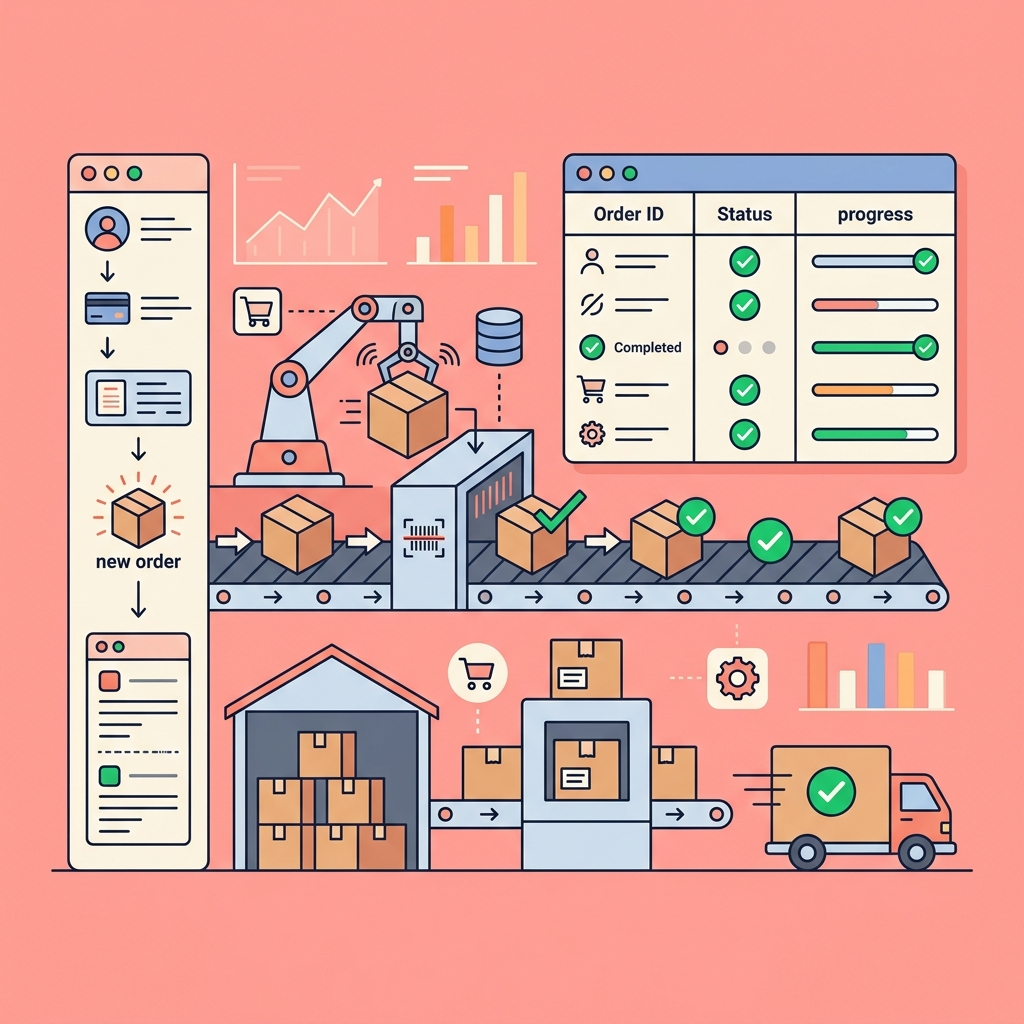
The pillars of order automation
Centralized Dashboard
View all pending, shipped, and completed orders in one single unified screen. Filter by date or status instantly.
Inventory Sync
Never accidentally sell an out-of-stock item again with live quantity tracking that updates the second a purchase is made.
Automated Receipts
The system generates a professional invoice and emails the customer their receipt instantly upon successful payment.
Shipping Integration
Generate, format, and print standardized shipping labels directly from the order page without re-typing anything.
Order Management FAQ
Absolutely. A website handles the transactions and catalog browsing, freeing you up to use WhatsApp strictly for high-value customer support, building relationships, and answering complex product questions.
Send a broadcast message with a special discount code that only works on your new website. Explain that the new system is to serve them faster. They will appreciate the seamless checkout experience.
No, you actually improve the experience. Customers who know exactly what they want can buy instantly without waiting for your reply, while customers who genuinely need help will still message you. It filters out the noise.
You can add custom text fields and file upload options directly on your website's product pages. The customer provides all the necessary details at checkout, completely eliminating back-and-forth messaging.
It is exponentially easier. Instead of scrolling through hundreds of chats to find an address, your dashboard presents all orders in a clean, filterable list. You can print 50 shipping labels with one click.
On average, a manual WhatsApp order takes 5-10 minutes of active chatting, payment verification, and data entry. For 50 orders, that is over 6 hours of manual work saved every single day.